What Is a Lone Worker Tracking Device?
A lone worker tracking device is a purpose-built hardware solution designed specifically for lone worker safety in high-risk or isolated environments. Unlike mobile apps, these lone worker safety devices operate independently with their own SIM connectivity, GPS/GNSS tracking, and dedicated battery systems.
Most devices include critical safety features such as SOS panic buttons, automatic man-down or fall detection, geo-fencing alerts, and multi-network connectivity for stronger coverage in remote locations.
Because they are built for industrial use, they are more reliable in environments where smartphones may be restricted, easily damaged, or impractical to carry, such as construction sites, mining workers’ safety, manufacturing plants, and oil & gas facilities.
What Is a Lone Worker Safety App?
A lone worker safety app is a software-based solution installed on an employee’s existing smartphone. These apps typically provide features such as GPS location tracking, timed check-ins, panic alerts, and two-way communication between workers and supervisors.
Since the system relies entirely on the worker’s smartphone, performance depends on battery life, cellular coverage, device condition, and operating system stability. However, safety apps are often faster and more affordable to deploy because companies can use devices employees already carry.
This approach works well for lower-risk environments and mobile teams such as healthcare workers, social workers, delivery staff, field technicians, and office-based employees who already depend on smartphones during daily operations.
The difference between a lone worker safety app and a dedicated tracking device becomes most visible when real emergencies happen in real working environments.
Also Read: Lone Worker Check-In System: TrackLone vs Manual Safety Methods
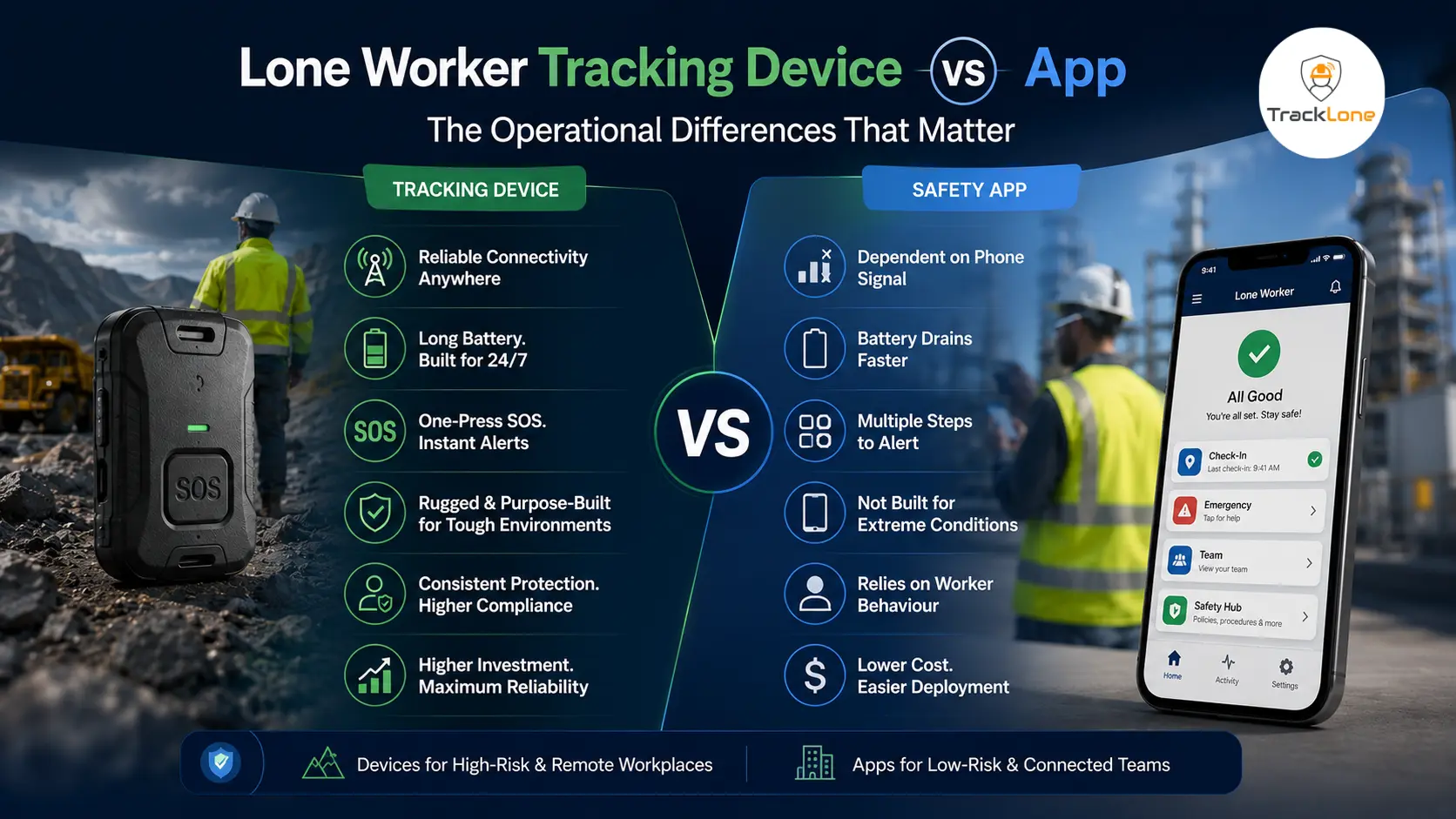
Lone Worker Tracking Device vs App: The Operational Differences That Matter
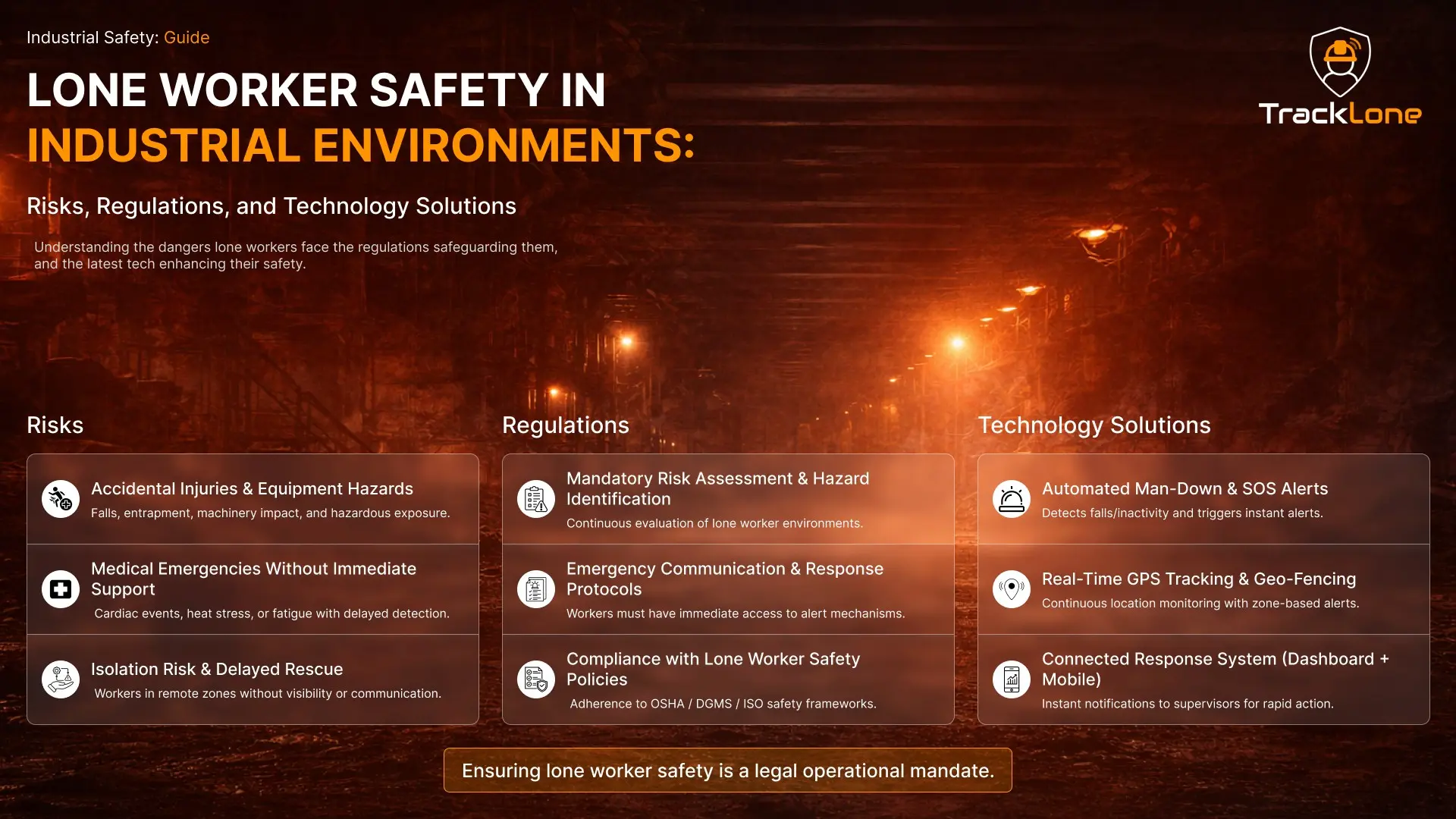
While both solutions offer worker monitoring and emergency alerts, their real-world performance differs significantly in high-risk environments. The choice is not just about features or pricing, it is about reliability when a worker needs help the most.
Comparison Factor | Dedicated Lone Worker Tracking Device | Lone Worker Safety App (Smartphone-Based) |
Connectivity & Coverage | Uses built-in 4G SIM, multi-network connectivity, or satellite communication to maintain worker visibility even in remote, underground, offshore, or low-signal environments. Suitable for mining, utilities, construction, and oil & gas operations. | Relies entirely on the smartphone’s cellular signal and internet connection. If the phone enters a dead zone or loses connectivity, worker monitoring stops immediately, creating significant safety risks. |
Battery Life & Reliability | Designed exclusively for worker safety with battery life typically ranging from 72–120 hours. No background applications consume power, ensuring reliable operation throughout long shifts. | Shares battery with calls, messaging, navigation, emails, and other applications. Heavy phone usage can quickly drain the battery, disabling the safety system when it is needed most. |
Hardware Durability | Industrial-grade, rugged hardware designed to withstand dust, water, vibration, drops, and harsh working environments. Many devices carry IP-rated protection suitable for industrial use. | Consumer smartphones are not designed for harsh industrial environments and are more susceptible to damage from water, dust, impacts, and extreme temperatures. |
Emergency SOS Activation | Features a dedicated physical SOS button that can be activated instantly, even while wearing gloves or during high-stress situations. | Requires workers to unlock the phone, open the application, and trigger the emergency alert manually, adding valuable seconds during critical incidents. |
Automatic Safety Features | Commonly includes automatic fall detection, man-down detection, no-motion detection, and other safety sensors that can trigger alerts even if the worker becomes unconscious. | Most apps rely primarily on manual activation. Automatic detection capabilities are generally limited and depend on smartphone sensors and permissions. |
Deployment Speed | Requires procurement, device configuration, SIM provisioning, and deployment planning before rollout. | Quick to deploy since employees already carry smartphones, making implementation faster and reducing initial setup time. |
Initial Investment | Higher upfront investment due to dedicated hardware, connectivity, and device management infrastructure. | Lower initial cost because no additional hardware is required beyond existing employee smartphones. |
Long-Term Operational Reliability | Built specifically for continuous worker safety monitoring, offering dependable performance and reduced operational risk over time. | Reliability depends on smartphone condition, user behaviour, operating system updates, app permissions, and battery availability, increasing the possibility of missed alerts. |
Worker Compliance | Workers simply carry a dedicated safety device designed for a single purpose, reducing compliance issues and ensuring consistent protection. | Success depends on workers keeping phones charged, carrying them at all times, allowing background operation, and avoiding accidental app closure or disabled permissions. |
Best Suited For | High-risk industries such as mining, construction, utilities, manufacturing, oil & gas, chemical plants, offshore operations, and isolated work environments where maximum reliability is essential. | Lower-risk workplaces, office environments, field sales, logistics, facility management, or organisations looking for a cost-effective safety solution where smartphone availability is reliable. |
Dedicated lone worker tracking devices provide superior reliability, emergency response, ruggedness, and compliance, making them the preferred choice for high-risk industries. Lone worker safety apps offer a lower-cost, faster-to-deploy alternative that works well for lower-risk environments where employees already carry smartphones.
The right lone worker safety solution depends less on technology preference and more on the actual risks workers face every day.
Which Industries Need a Device vs an App?
Different industries operate under very different safety conditions, connectivity challenges, and compliance requirements. What works effectively for a healthcare worker in an urban area may fail completely on a remote mining or construction site.
That is why EHS leaders should evaluate safety tools based on operational risk exposure, environmental conditions, and emergency response reliability. Here’s how the choice typically aligns across industries.
Environment | Recommended Approach | Why |
Construction, mining, oil & gas | Dedicated device | No-phone zones, connectivity gaps, physical hazards |
Utilities and remote field operations | Dedicated device | Rural dead zones, high-voltage risk |
Healthcare (community/home visits) | App (with device backup) | Urban setting, smartphone-comfortable workforce |
Manufacturing with restricted phone zones | Dedicated device | Policy and physical risk alignment |
Many organisations ultimately adopt a hybrid approach, deploying dedicated devices for industrial and field workers while using smartphone apps for office-adjacent or lower-risk employees.
The decision should always be risk-based rather than budget-first. For EHS teams, the safest solution is the one that remains reliable when conditions become unpredictable.
As operational risks increase, many industrial organisations move beyond app-only safety models toward dedicated worker protection systems.
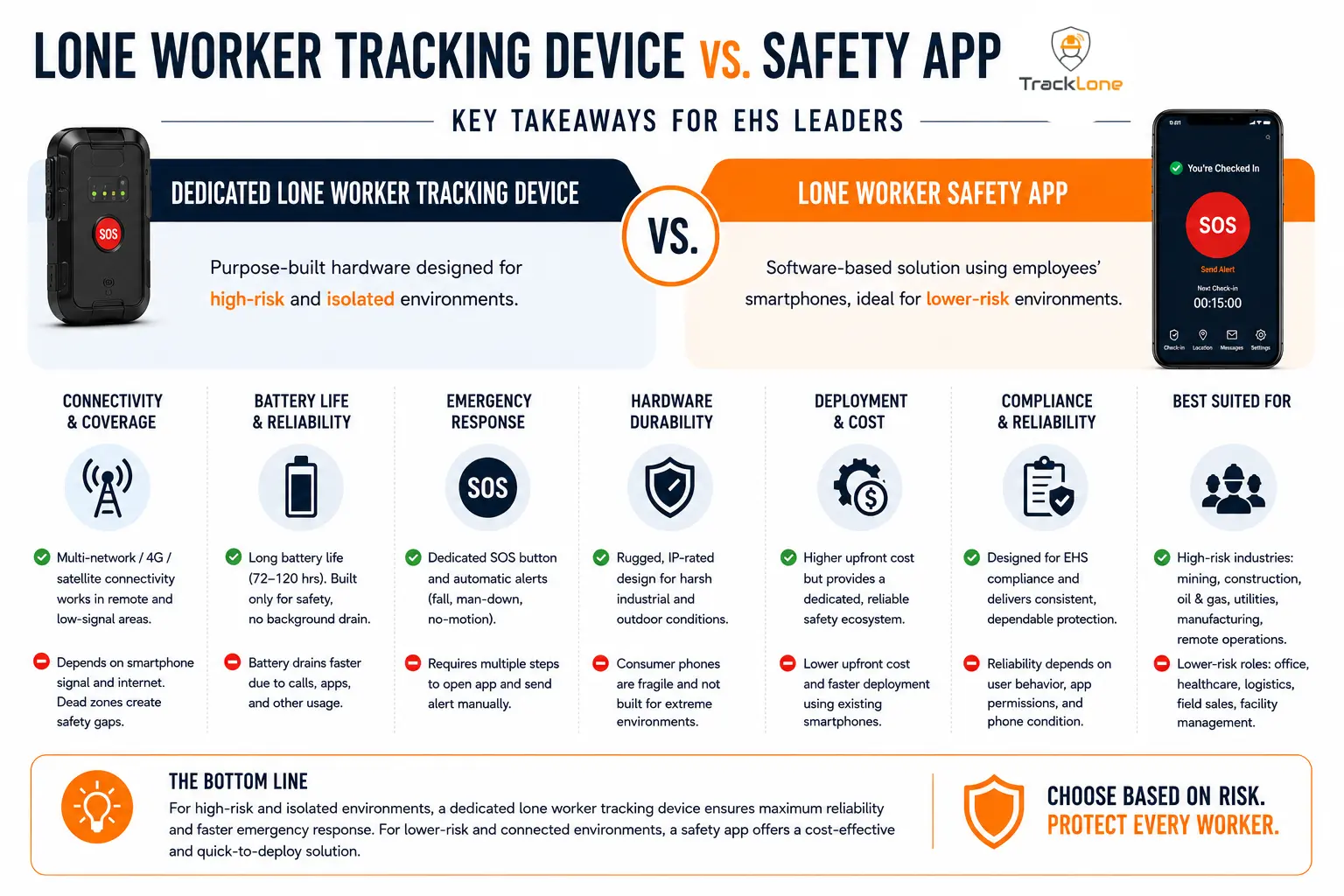
Decision Framework: Should EHS Choose a Lone Worker Safety App or a Dedicated Tracking Device?
Every workplace has different operational risks. The right solution depends on the level of risk, the working environment, and your organisation’s safety objectives.
Quick Decision Checklist
If your organisation… | Recommended Solution |
Has workers operating in remote, isolated, or low-network coverage areas | ✅ Dedicated Lone Worker Tracking Device |
Requires automatic fall detection, man-down detection, or no-motion alerts | ✅ Dedicated Lone Worker Tracking Device |
Operates in mining, construction, manufacturing, utilities, oil & gas, or other hazardous industries | ✅ Dedicated Lone Worker Tracking Device |
Needs rugged, industrial-grade hardware that can withstand dust, water, vibration, and harsh environments | ✅ Dedicated Lone Worker Tracking Device |
Must comply with strict EHS policies and reduce operational safety risks | ✅ Dedicated Lone Worker Tracking Device |
Wants the fastest deployment with minimal upfront investment | ✅ Lone Worker Safety App |
Has employees already carrying company-issued smartphones in low-risk environments | ✅ Lone Worker Safety App |
Wants the highest level of worker protection and operational reliability | ✅ Dedicated Lone Worker Tracking Device |
Also check , What EHS Managers Should Look for in a Lone Worker Protection System
How TrackLone Addresses These Challenges in High-Risk Operations
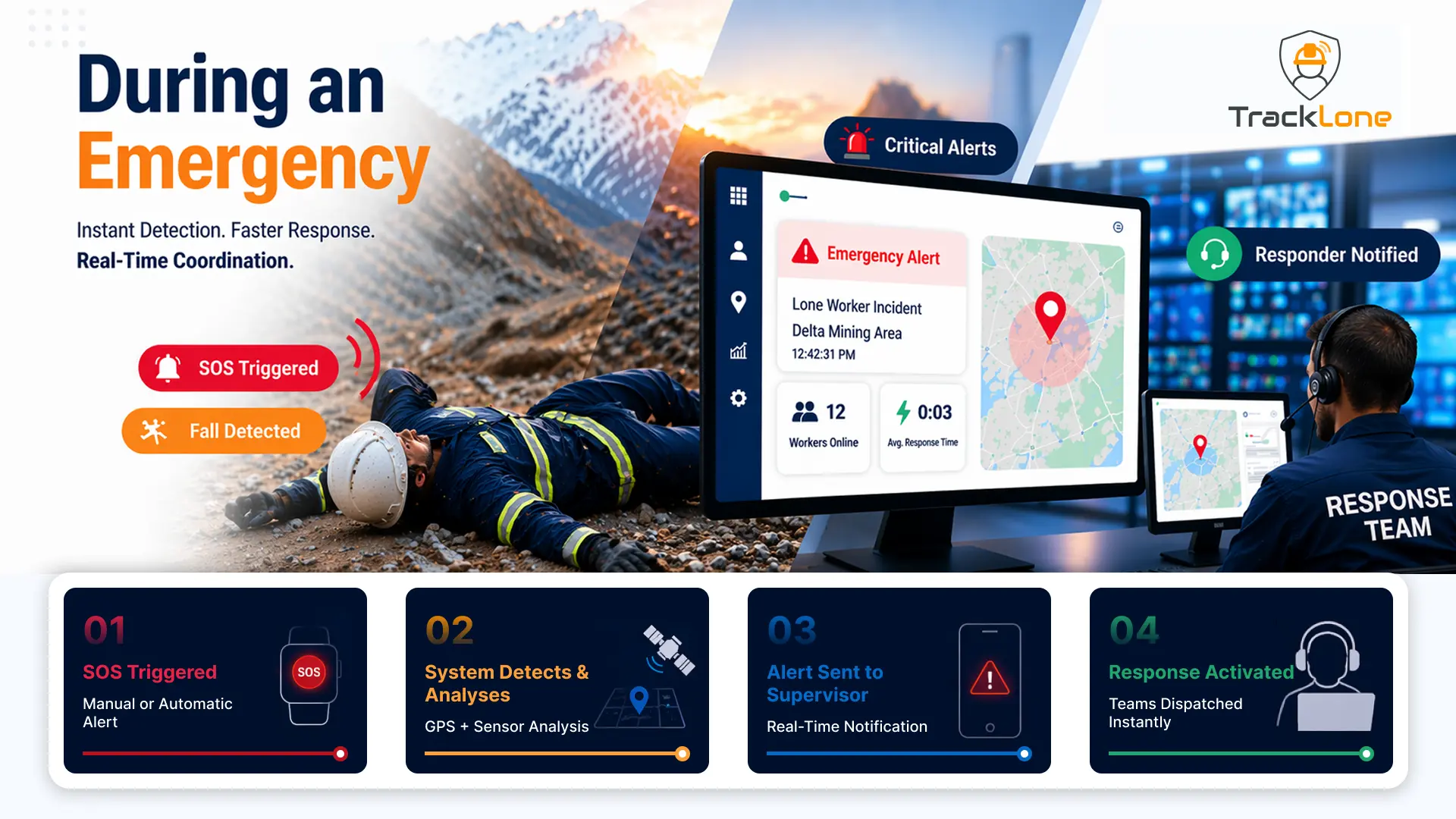
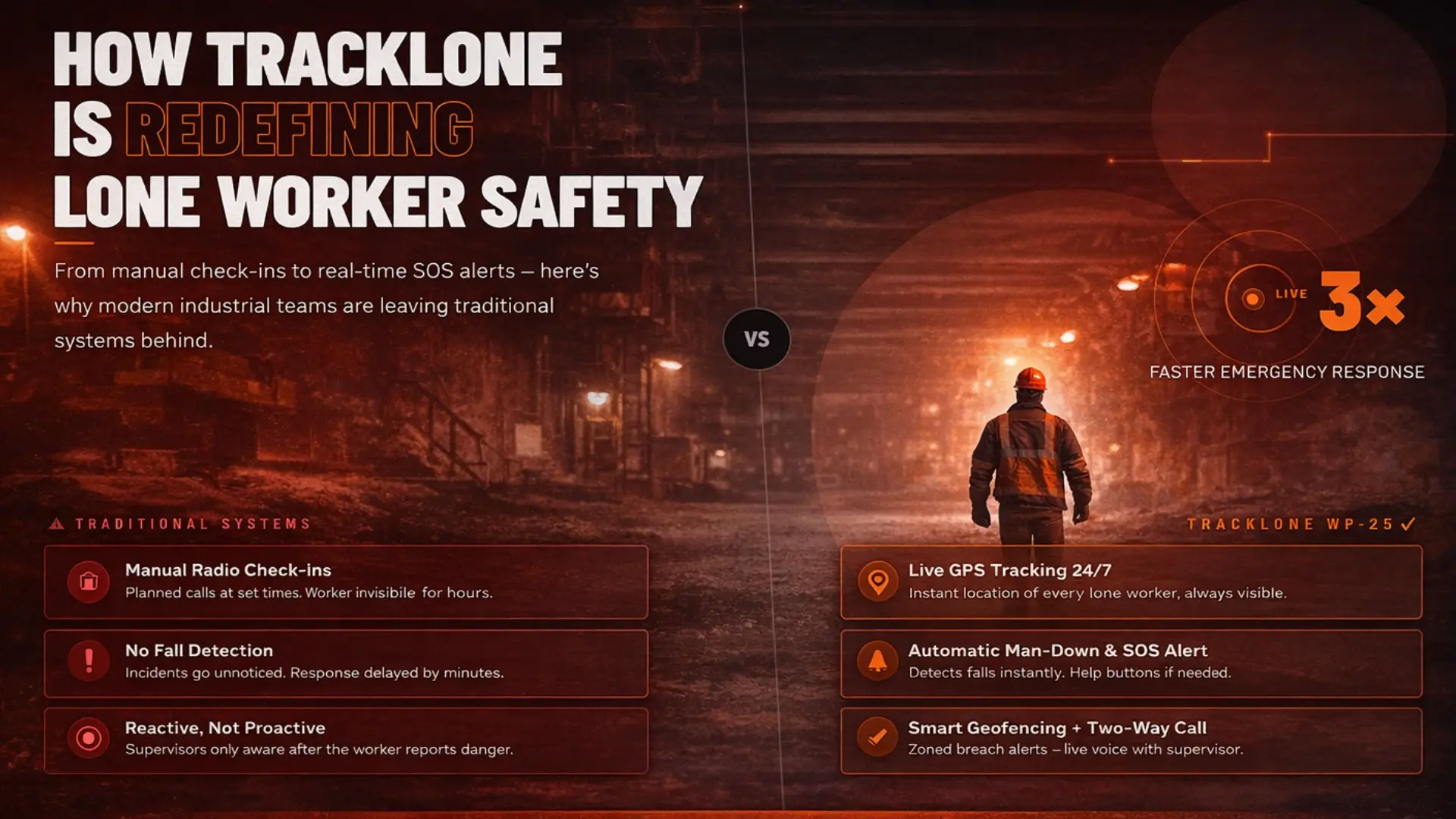
TrackLone is a custom-built industrial lone worker safety device, not adapted from a consumer smartphone app. Its rugged safety device uses dedicated 4G SIM connectivity, GPS/GNSS tracking, geo-fencing, automatic man-down detection, and a one-touch SOS button for rapid emergency response in high-risk environments.
The platform also provides a centralised cloud dashboard with real-time worker visibility, incident alerts, and historical compliance logs to support ISO 45001 and OSHA reporting. By combining hardware (WP 25 lone worker safety device) and software (Dashboard) into a closed IoT safety loop, TrackLone helps EHS teams reduce blind spots, improve emergency response, and maintain reliable worker protection independent of personal smartphones.
Protect lone workers with a safety system built for real industrial risks, not consumer-device limitations. Request a demo today!
Conclusion
Lone worker safety apps and dedicated devices both have valid use cases, but they are not operationally equal. In high-risk industries such as construction, mining, manufacturing, and utilities, dedicated tracking devices provide the reliability, automatic detection, and connectivity resilience that smartphone apps often cannot guarantee. For lower-risk environments, apps may be sufficient when deployed with clear awareness of their limitations.
The real decision for EHS teams is not simply about cost or convenience; it is about acceptable safety risk during an emergency.
Safeguard your workforce with a lone worker safety solution built for real industrial conditions.
Connect with TrackLone to explore a purpose-built IoT safety system tailored to your operations.