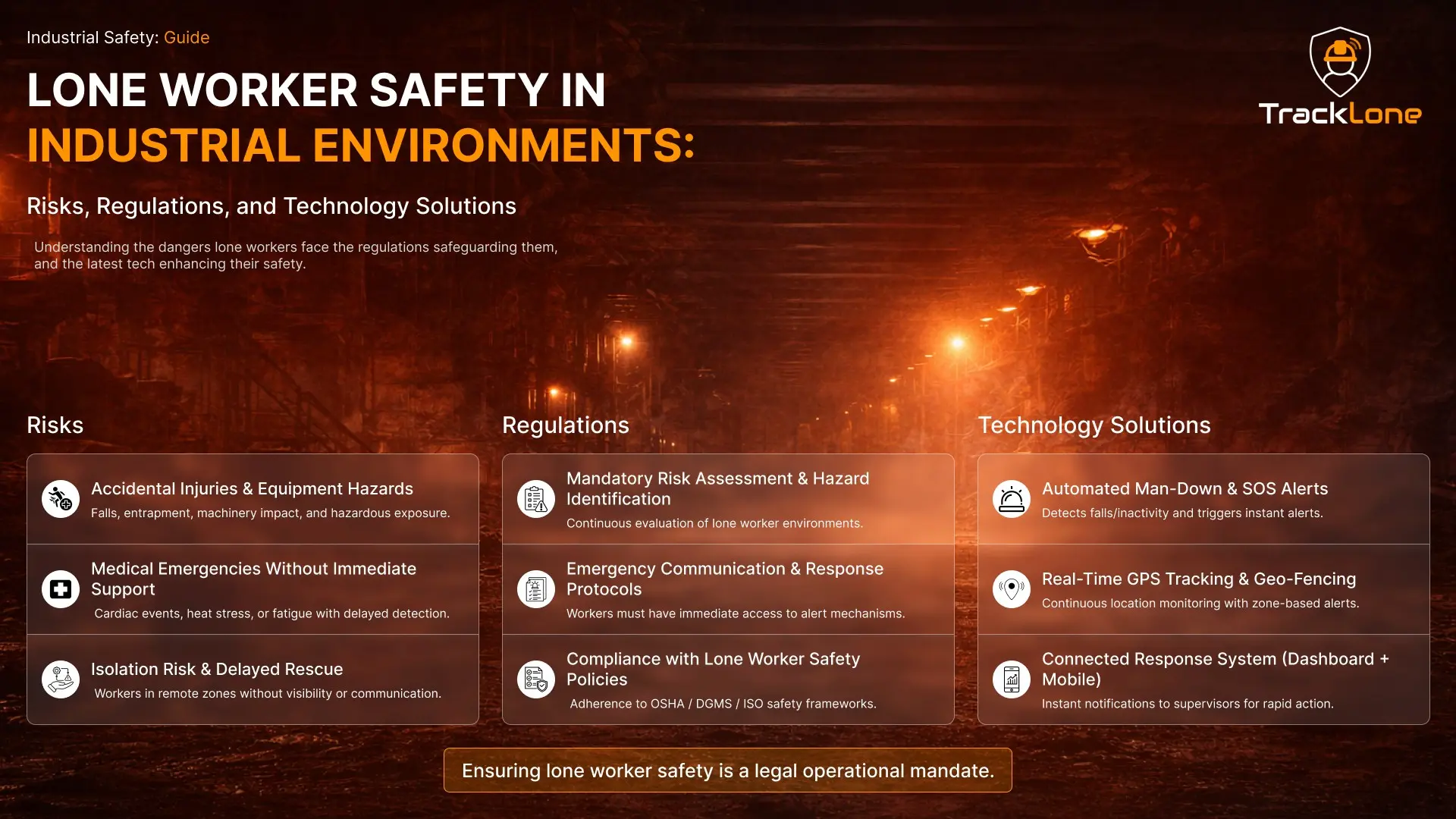
What happens if a worker misses a check-in, and no one realizes it for hours?
That’s the biggest flaw in manual systems. 68% of organizations have experienced lone worker incidents, with many classified as severe. At the same time, 64% of companies reported lone worker safety incidents in the last three years, highlighting how common these risks are. Manual check-ins rely on human consistency, and that’s where they fail.
This is why businesses are shifting to a smarter lone worker check-in system. In this blog, we compare TrackLone vs manual methods, showing how IoT-driven automation enables instant alerts, faster response, and complete workforce visibility, so your safety strategy actually works when it matters most.
What is a Lone Worker Check-In System?
A lone worker check-in system is not just about marking attendance; it’s a time-bound safety trigger designed to ensure that a worker is safe at every critical interval of their shift.
In high-risk environments, even a 15–30 minute delay in response can turn a minor incident into a serious emergency. This system eliminates that risk by creating mandatory safety touchpoints. Here’s how it works in practice:
- Workers confirm their status at predefined intervals.
- The system tracks whether the check-in is completed on time.
- If missed, it automatically flags a potential risk and escalates alerts.
Now that you know how a check-in system should work, let’s look at where manual methods start breaking down in real situations.
Also Read – Lone worker tracking devices features
Why Manual Check-In Systems Fail in Critical Safety Situations
Manual check-in systems depend heavily on human consistency, and that’s their biggest weakness. In high-risk environments, even a small delay or missed check-in can go unnoticed until it’s too late. This is where the manual check-in system fails:
- Missed or Delayed Check-Ins: Workers may forget to report, especially during long shifts or high workload.
- No Real-Time Visibility: Supervisors don’t know the worker’s exact location or movement at the time of risk.
- Delayed Emergency Response: Issues are identified only after someone notices a missed check-in, often too late.
- No Automatic Alerts: There’s no system-triggered escalation; everything depends on manual follow-up.
- Weak Record Keeping: Paper logs or calls are hard to track, verify, and use for compliance audits.
If manual systems leave gaps, the next question is, what does a reliable, modern check-in system actually look like?
TrackLone: An IoT-Based Lone Worker Check-In System Built for Real-Time Safety
TrackLone is a lone worker check-in system designed to replace manual follow-ups with automated, continuous safety monitoring. It combines a field device (carried by the worker) with a central dashboard (used by supervisors), creating a closed safety loop where no event goes unnoticed.
Instead of relying on workers to remember check-ins, TrackLone ensures every safety status is either confirmed or automatically escalated. Here’s how it works in practice:
- The worker carries the TrackLone device during the shift
- The system continuously monitors movement, location, and activity
- If a check-in is missed or a risk is detected → instant alert is triggered
- Supervisors receive live location + incident data on the dashboard
Now that you’ve seen how TrackLone works, let’s compare it directly with manual systems, because the difference becomes clear when you look at real-world performance.
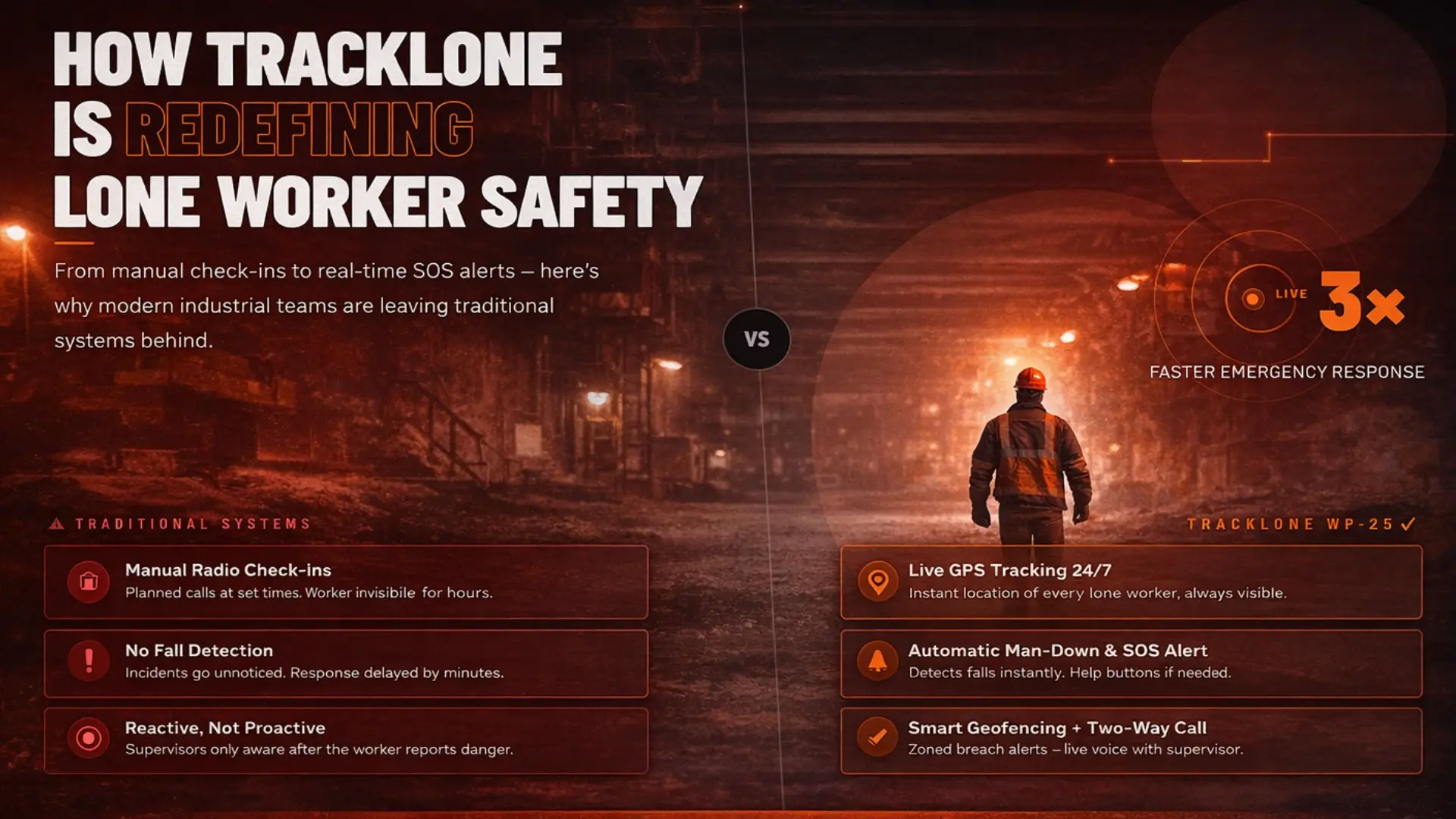
TrackLone vs Manual Check-In Systems: A Detailed Safety Comparison
When it comes to lone worker safety, the difference is in how quickly and reliably a system responds when something goes wrong. Manual systems are reactive, while TrackLone is designed to act instantly and automatically.
Below is a detailed side-by-side comparison:
Safety Factor | Manual Check-In System | TrackLone |
Check-In Process | Worker must remember to report | Automated + continuously monitored |
Missed Check-Ins | Often noticed late or ignored | Instantly detected and escalated |
Emergency Alerts | Manual calls or messages | SOS + auto alerts (fall, no-motion) |
Location Visibility | Not available or inaccurate | Live GPS with route history |
Supervisor Action | Depends on follow-ups | Instant alerts with actionable data |
Compliance & Records | Manual logs, error-prone | Automated logs with timestamps |
The comparison makes one thing clear: automation wins. But what exactly inside TrackLone makes it so effective in real-world safety situations?
Core Features That Make TrackLone a More Reliable Lone Worker Check-In System
TrackLone goes beyond basic check-ins by combining real-time detection, instant communication, and continuous monitoring into one system. Instead of relying on a single trigger, it creates multiple safety layers that work together to reduce risk and response time.
Let’s break down the specific features that make this possible:
1. Instant Emergency Alerts & Communication
TrackLone enables workers to raise an alert instantly using the SOS button, which shares their live location with supervisors in real time. At the same time, two-way calling allows immediate communication to understand the situation. This removes the delay of manual escalation and ensures faster, direct response during critical moments.
2. Automated Incident Detection (Fall & No-Motion)
The system continuously monitors worker activity to detect sudden falls or extended inactivity. If a worker is unable to respond, TrackLone automatically triggers an alert without requiring any manual input. This is critical in scenarios where the worker is unconscious or immobilized, ensuring no incident goes unnoticed.
3. Real-Time Location Tracking with Context
TrackLone provides live GPS tracking along with route history, giving supervisors complete visibility of worker movement. This helps teams not only locate the worker instantly but also understand where the incident occurred and how the worker reached that point, enabling faster and more informed decisions.
4. Geo-Fencing for High-Risk Zone Monitoring
Supervisors can define safe and restricted zones, and TrackLone automatically sends alerts when workers enter or exit these areas. This is especially useful in hazardous environments where access needs to be controlled, ensuring proactive risk prevention instead of reactive response.
5. Check-In Logs & Compliance Tracking
Every check-in, alert, and action is automatically recorded with timestamps, creating a verifiable digital trail of worker activity. This simplifies compliance with safety regulations and provides clear documentation during audits, reducing reliance on manual logs that are often incomplete or inaccurate.
6. Device Health & System Reliability Monitoring
TrackLone continuously tracks battery levels, network status, and device activity to ensure the system is always operational. If the device is inactive or at risk of failure, alerts are generated proactively, ensuring that the safety system itself doesn’t become a point of failure.
Understanding the features is one thing, but knowing when to move away from manual methods is what truly impacts safety outcomes.
When and Why to Upgrade from Manual Check-Ins to TrackLone
If your current safety process depends on calls, messages, or paper logs, you’re operating with built-in delays and blind spots. Upgrading to TrackLone is not just a tech shift, it’s a move from reactive safety to real-time protection.
Key benefits of switching to TrackLone:
- Faster Emergency Response: Instant alerts with live location ensure incidents are acted on within seconds, not hours
- Zero Dependency on Manual Follow-Ups: Automated detection (fall, no-motion, missed check-ins) removes reliance on human memory
- Complete Real-Time Visibility: Supervisors can track worker location, movement, and status at any moment
- Improved Worker Safety in High-Risk Zones: Geo-fencing and continuous monitoring reduce the chances of unnoticed incidents
- Stronger Compliance & Audit Readiness: Automated logs provide accurate, timestamped records for reporting and audits
- Scalable for Multi-Site Operations: Monitor multiple workers and locations from a single centralized dashboard
- Higher Workforce Accountability: Digital check-ins and activity tracking ensure workers remain connected and monitored.
Final Thoughts
Manual check-in systems were built for simpler operations, but today’s high-risk environments demand speed, accuracy, and real-time visibility. As we’ve seen, manual methods rely on human consistency, leading to missed check-ins, delayed responses, and limited situational awareness.
TrackLone changes this completely. By combining automated alerts, live tracking, and centralized monitoring, it ensures that every worker is continuously protected, not just periodically checked.
For businesses operating across mining, manufacturing, construction, or oil & gas, this isn’t just an upgrade; it’s a critical shift toward proactive safety management.
The difference is clear: manual systems react late. TrackLone responds instantly.
Don’t let a missed check-in turn into a serious incident. Request a Demo to see TrackLone in action.
FAQs
What is a lone worker check-in system?
A lone worker check-in system is a safety solution that ensures workers operating alone regularly confirm their safety status. Modern systems use automated alerts, real-time monitoring, and incident detection to ensure that if a worker fails to check in or faces an emergency, supervisors are notified immediately.
What happens if a lone worker misses a check-in?
In automated systems like TrackLone, a missed check-in triggers alerts to supervisors, allowing immediate follow-up and ensuring worker safety is not compromised.
What features should a modern lone worker check-in system include?
A reliable lone worker check-in system should include:
- Man-down (fall detection) alerts
- SOS emergency trigger
- No-motion detection
- Real-time location tracking
- Geofencing for restricted zones
- Automated check-in logs and compliance tracking
How does a lone worker check-in system improve compliance?
It creates automated, timestamped records of check-ins, alerts, and responses, making it easier to meet EHS and audit requirements.
Is a lone worker check-in system suitable for small teams?
Yes, even small teams benefit from automated safety monitoring, as it reduces manual effort and ensures consistent protection without additional supervision.